VOCs
(Volatile Organic Compounds)
VOCs(Volatile Organic Compounds)?
-
Volatile Organic Compounds (VOCs) are carcinogenic substances that cause disorders in the nervous system and other organs when inhaled or absorbed through skin contact.
-
Due to their high vapor pressure, they volatilize easily into the atmosphere.
-
They are also primary contributors to unpleasant odors and the formation of ground-level ozone.
-
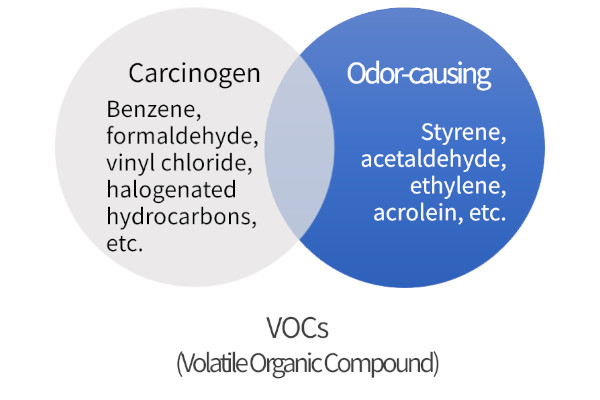
VOCs
-
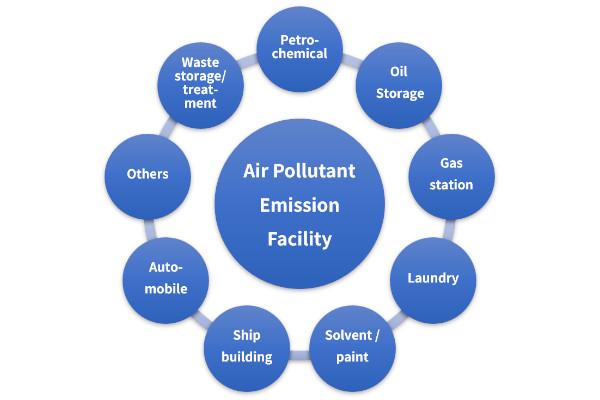
VOCs emission facility
VOC and Odor Removal
Adsorption/
Regeneration Process
Activated Carbon Adsorption and Regeneration Process
-
Adsorption occurs due to van der Waals forces between the surface of the activated carbon and the VOC molecules.
-
Activated carbon possesses an immense specific surface area—typically exceeding 1,000m2 and consists of three distinct pore structures: macropores, mesopores, and micropores.
-
Due to the varying sizes of these pores, adsorption occurs sequentially from macropores → mesopores → micropores.
-
The process exhibits powerful VOC gas removal and deodorization efficiency (exceeding 95%)
-
While the initial adsorption rate is very high, it decreases over time, leading to an increase in outlet concentration.
-
This stage is known as the breakthrough point (break point); once this point is passed, efficiency drops sharply.
-
To extend the operational lifespan, a separate regeneration process is required.
-
VOCs and odorous substances
-

Activated Carbon filter module
-
Clean air
VOC and Odor Removal
Microwave
Oxidation Technology
Microwave oxidation mechanism

Features of microwave oxidation technology
-
This technology treats VOCs, hazardous gases, and odorous compounds through oxidation and combustion reactions at high temperatures.
-
As a flameless process that does not require auxiliary fuel, it offers the advantage of generating no secondary pollutants.
-
The system features a rapid initial heat-up rate (~200℃/min), allowing for "on-demand" operation only when necessary.
-
Furthermore, the use of high-concentration treatment and localized heating methods enables the miniaturization of the oxidizer unit.
-

Microwave oxidizer schematic
-

Microwave oxidizer simulation
Comparison of Regenerative Thermal Oxidizers (RTOs) and Regenerative Microwave Oxidizers (RMOs)
| Category | Regenerative Thermal Oxidizer (RTO) | Regenerative Microwave Oxidizer (RMO) |
|---|---|---|
| Operating Temp. | 800~900℃ | 800~900℃ (max.1100℃) |
| Preheating Time | Requires several hours to preheat ceramic media. | Rapid heating; preheats in minutes to tens of minutes. |
| Energy Consumption | Requires continuous auxiliary fuel for low concentrations. | Maintains temperature easily at low to medium concentrations. |
| Heat Recovery | Over 95% heat recovery via ceramic media. | Over 70% heat recovery using an economizer. |
| Equipment Footprint | Large installation area due to the combustion chamber. | Compact design (1/2 to 1/3 the size) with no separate chamber. |
| Maintenance | High risk of mechanical failure due to rotors and numerous valves. | Simple mechanical structure leads to very low maintenance costs. |
| Primary Applications | High-flow, medium-concentration VOCs. | Low-to-medium flow VOCs. |