Microwave
Dryer Features
Microwave dryer features
-
Drastic Reduction in Drying Time: By directly heating water molecules, drying time can be significantly reduced by 25% to 90%.
-
Reduced Operational Costs: Lower energy consumption compared to conventional methods, combined with a compact design and fast cycle times, leads to overall cost savings.
-
Ultra-Low Moisture Content: Capable of drying materials down to a moisture content of 1% or less, which is extremely difficult to achieve with traditional drying methods.
-
Prevention of Over-Drying: Because it does not rely on traditional heat transfer (conduction/convection), the heating speed is exceptionally fast. This minimizes surface hardening, carbonization, or cracking caused by prolonged heat exposure.
-
Material Integrity: Drying occurs at relatively low temperatures (approx. 70~80°C based on exhaust temperature), minimizing damage to the raw materials.
-
Eco-Friendly Process: Since no fossil fuels are used, the process is free from combustion exhaust gases, allowing for the minimization of secondary environmental control equipment.
Primary Applications of Microwave Dryers
-
Food Industry: Agricultural products, grains and nuts, tea leaves and medicinal herbs, sterilization, and thawing.등
-
Chemical & Advanced Materials: Secondary battery materials (cathode and anode raw materials), ceramics and catalysts, high-purity ceramic raw materials, graphene, and nano-materials.조
-
Pharmaceuticals & Cosmetics: Raw powders for tablets and capsules, natural extract powders, mask pack sheets, etc.
-
Textiles & Wood: Drying of thick timber/lumber and fabric drying.
-
Waste Management: Volume reduction of sewage sludge and industrial waste.
Dryer manufacturing
design process
Dryer manufacturing process
- - Output [ton/day]
- - Moisture [%]
- - Raw material
ingredients
- - Continuous
- - Batch
- - Direct/Indirect
- - Atmosphere
(Vacuum, etc.)
- - Calculate Calories
- - Calculate Power
- - Calculate add. heat
- - Frequency select
- - Chamber simul.
- - Choke simul.
- - Antenna simul.
- - Block seletion
- - Stage selection
- - Final layout
decision
- - Utilities
- - Hook-up facility
- - Production design
Drying System Selection
-
Various configurations—including continuous (conveyor), batch, and vertical types—can be adopted, allowing for selective application tailored to the specific requirements of the site.
-

Continuous (conveyor)
-

Batch type
-

Vertical type
Microwave Power Selection
-
Pilot Testing: Conduct pilot drying tests on target materials as required to verify performance.
-
Heat Requirement Calculation: Calculate the required heat capacity based on the specific physical properties and moisture content of the target material.
-
System Calibration: Select the appropriate frequency and calculate the required microwave power based on the chosen drying method (Continuous, Batch, or Vertical).
-
Energy Integration: Review the application of waste/idle energy (such as steam or other thermal sources) from the existing process as a supplementary heat source to maximize efficiency.
-

Example of calculating required heat by material balance
-

Example of P&ID and PFD creation linked to pre- and post-equipment
Microwave Simulation
-
Uniform Energy Distribution: Simulation of microwave dryer modules to ensure a uniform electromagnetic field distribution across the target area.
-
Leakage Shielding: Simulation of shielding modules designed to perfectly block microwave leakage to the exterior of the device for operator safety.
-
Heating Method Geometry: Geometric simulation of the system structure optimized for specific heating methods (conduction, convection, or direct radiation).
-
Transmission Optimization: Simulation of microwave transmission lines and antennas to minimize power attenuation (loss) during energy delivery.
-

Uniform distribution simulation
-

Leakage prevention shielding simulation
-

Shape simulation according to heating method
Determining Microwave Dryer Layout
-
Module Arrangement: Arrange microwave modules to meet power requirements based on uniform distribution simulations.
-
Spatial Optimization: Configure modules in single-tier or multi-tier arrays to optimize the footprint based on the available installation space at the site.
-
System Configuration: Select between Batch-type or Vertical-type configurations to best suit the operational flow.
-
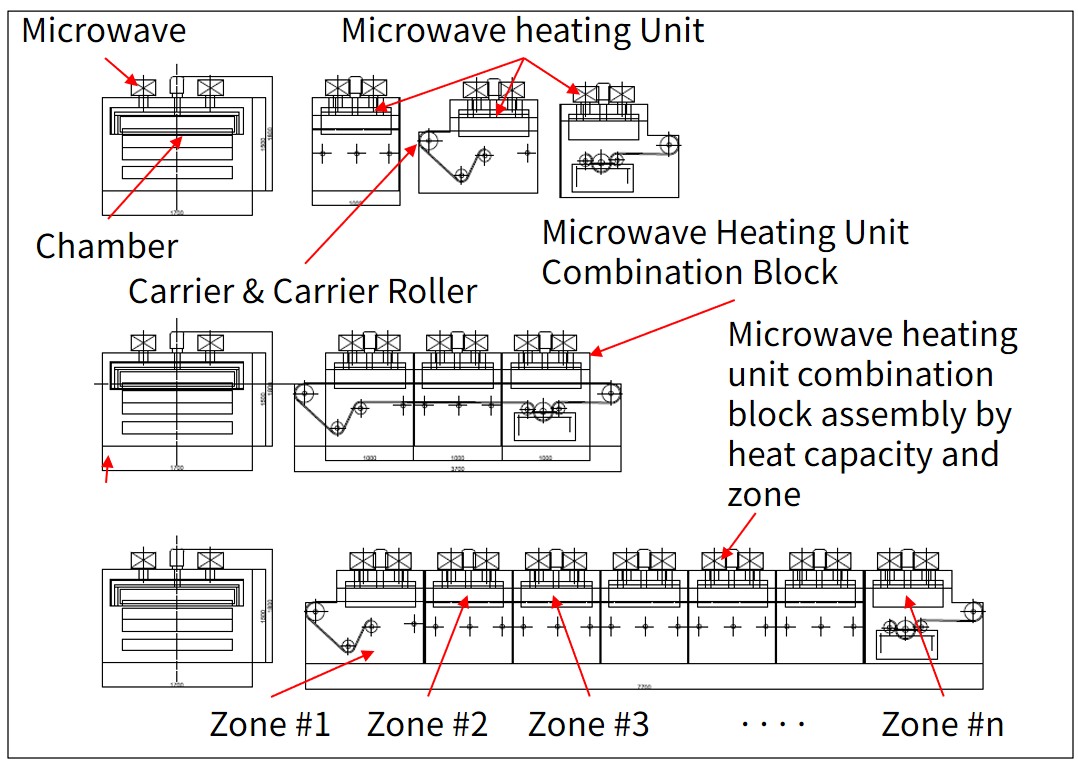
Block design and combination
-

Final layout decision
Microwave
Representative dryer performance
-

70kW large ceramic honeycomb dryer
-

470kW battery raw material dryer
-

160kW pouch preheater
-

195kW TiO2 raw material dryer
-

68kW-class laminated ceramic raw material dryer
-

50kW batch wood vacuum dryer