Microwave
Drying
Technology
Key Features of Microwave Drying Technology
High Speed and Energy Efficiency
-
Significant Time Reduction: By directly heating water molecules, drying time can be drastically reduced by 25% to 90%.
-
Lower Operating Costs: Compared to conventional methods, it offers lower energy consumption, equipment miniaturization, and faster operational cycles.
Superior Product Quality
-
Ultra-Low Moisture Levels: Achieves moisture content levels below 1%, a target extremely difficult to reach with traditional drying.
-
Prevention of Thermal Damage: Since it does not rely on external heat transfer (conduction/convection), it eliminates common over-drying issues such as surface hardening (case hardening), carbonization, and cracking caused by prolonged heat exposure.
-
Low-Temperature Processing: Drying occurs at relatively low temperatures (approx. 70–80°C based on exhaust temperature), minimizing damage to the raw material's properties.
Internal Volumetric Heating
-
Uniform Drying: Microwaves penetrate deep into the material to heat the entire volume simultaneously (inside-out), ensuring uniform results and preventing localized hot spots.
-
Bulk Processing: Facilitates relatively uniform heating and drying even for thick or high-density materials.
Eco-Friendly Operations
-
Zero Emissions: As it does not use fossil fuels, it is free from flue gas emissions, minimizing the need for secondary environmental treatment facilities.
-
Clean Environment: Equipped with negative pressure systems for moisture extraction, preventing contamination of the surrounding installation space.
High Integration & Versatility
-
Hybrid Systems: Can be flexibly integrated with existing technologies such as hot air, vacuum, or freeze-drying for diverse industrial applications.
-
Flexible Configurations: Easily adaptable into various formats, including continuous conveyor or batch-type systems.
Simultaneous Sterilization
-
Contamination-Free: Unlike conventional methods that use heated external air—which carries a risk of secondary contamination—microwave technology heats the material itself.
-
In-situ Sterilization: Enables effective sterilization during the drying process without the need for external air contact, ensuring high hygienic standards..
-
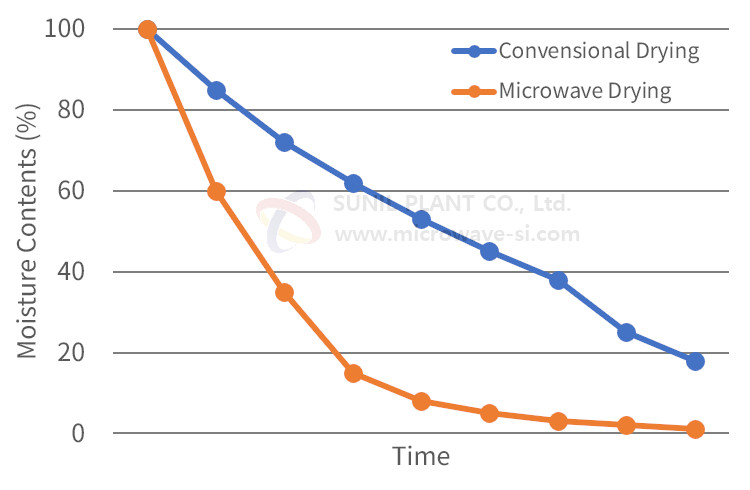
Drying time comparison
-
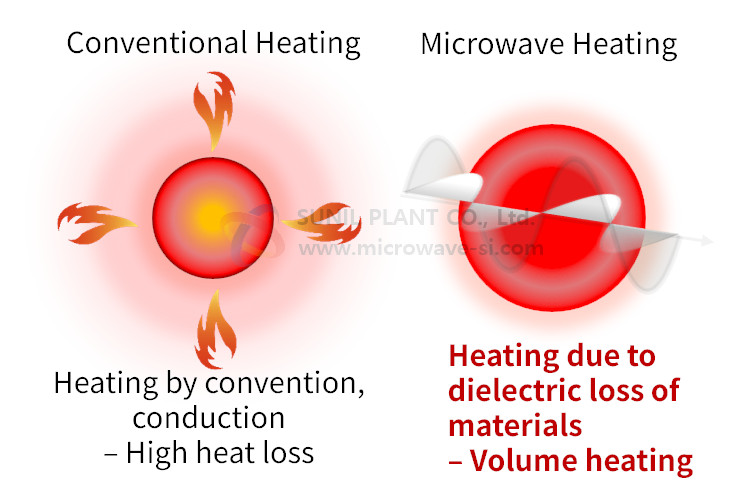
Heating method comparison
Advantages and
Disadvantages of
Microwave Drying
Technology
Key Characteristics of Microwave Drying Technology
Energy Efficiency
-
Conventional Drying: Since these systems heat external air and transfer heat from the material's surface, a significant amount of energy is lost to the atmosphere. Furthermore, reaching the core of the material requires substantial energy consumption.
-
Microwave Drying: Microwaves directly vibrate internal molecules to generate heat. Because there is no need to heat the surrounding air, energy efficiency is 25% to 50% higher than that of conventional drying methods.
Time and Labor Costs
-
Superior Speed: Microwave drying offers overwhelmingly fast processing times. For example, in timber drying, a process that takes 24 hours with conventional methods can be completed within tens of minutes using microwaves.
-
Ease of Automation: The technology is highly conducive to process automation, allowing equipment to be operated with minimal personnel for management and oversight.
Maintenance and Service Life
-
Reduced Thermal Stress: Since microwave systems operate at relatively low temperatures (approx. 70–80°C), there is almost no thermal damage to internal components.
-
Cost Minimization: The lack of extreme heat stress leads to a longer equipment lifespan and significantly reduces overall maintenance expenditures.
Comparison of regular drying and microwave drying
| Category | Conventional Drying (Hot Air / Electric) | Microwave Drying |
|---|---|---|
| Initial Capital Investment (CAPEX) | Low (Relatively inexpensive) | High (Core components are costly) |
| Energy Costs | High (Large heat loss due to air heating) | Low (Superior efficiency via direct internal heating) |
| Drying Time | Long (Several hours to several days) | Short (Approx. 1/10 of conventional drying time) |
| Installation Space | Large (Requires long drying lines and vast floor space) | Compact (Space-saving due to smaller footprint) |
| Quality Maintenance | High Defect Risk (Issues like surface hardening/crusting) | High Quality (Reduced defect rates via uniform drying) |
| Sterilization | Difficult (High volume of external air intake increases contamination risk) | Easy (Heats the material directly, facilitating in-situ sterilization) |