Activated
Carbon
Tower, ACT
An Adsorption Tower is an air pollution control facility designed to remove pollutants by adsorbing contaminated gases onto an adsorbent material.
Features of the Activated Carbon Adsorption Filter
-
High Specific Surface Area: Possesses an exceptionally large specific surface area for maximum contact.
-
Sequential Adsorption: Features diverse pore sizes, allowing for sequential adsorption in the order of Macropores → Mesopores → Micropores.
-
Superior Performance: Delivers powerful removal of VOC gases and deodorization performance (efficiency of 95% or higher).
-
Low Pressure Drop: Designed in a Honeycomb structure to minimize pressure loss within the system.
-
Reusable via Regeneration: Capable of reuse through thermal regeneration (can be regenerated and reused before reaching the saturation breakthrough point).
Applications
-
Organic solvents
-
Chemical manufacturing
-
Printing and printed materials
-
Paint and coating processes
-
Gas processing
-
Plastic manufacturing
This system is highly effective for removing Volatile Organic Compounds (VOCs) and odors generated in various industries, including:
-

Activated Carbon Adsorption Filter
-
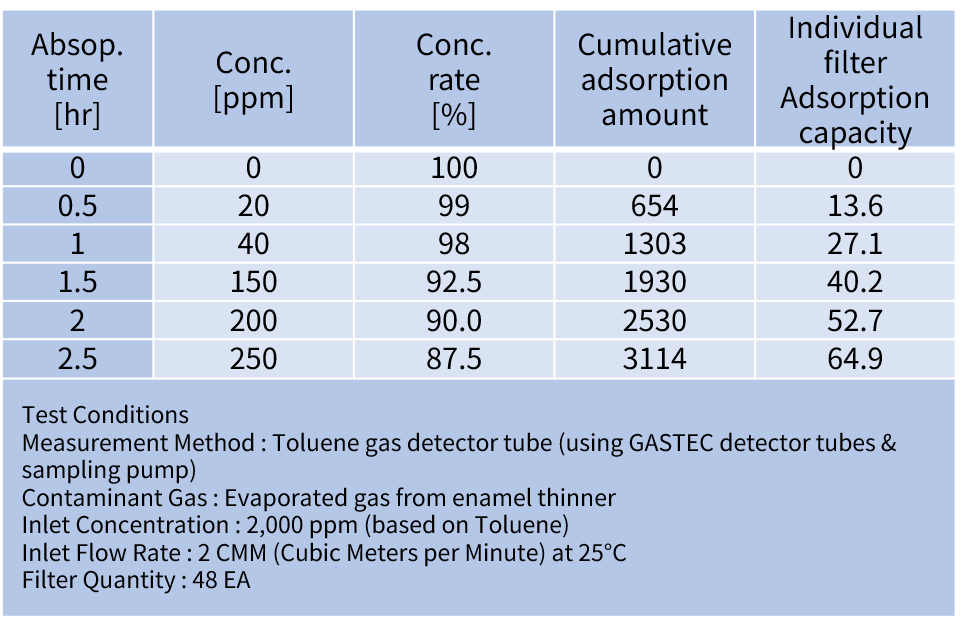
VOCs adsorption test
-
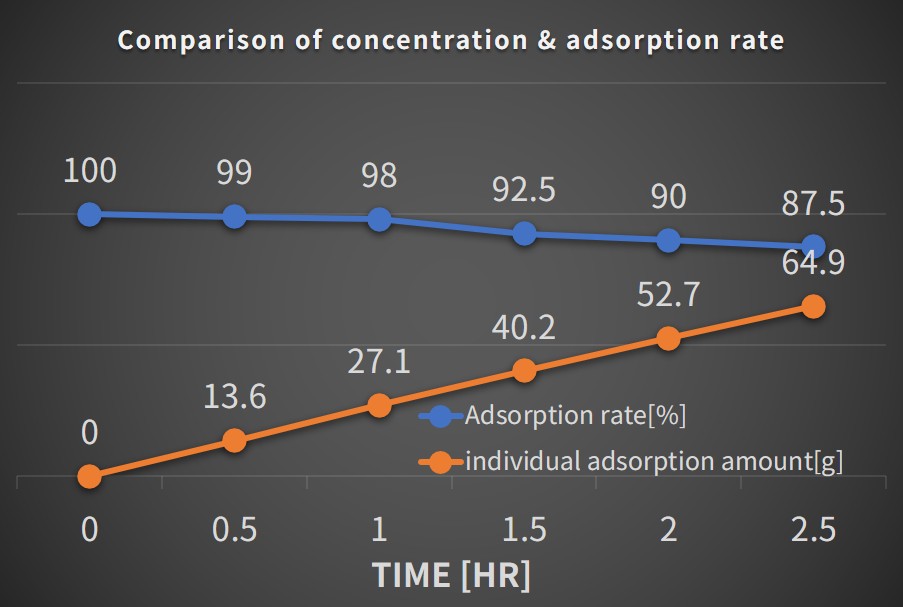
Comparison of individual concentration and adsorption rates
Product specifications
Size and power may vary depending on gas composition.
| MODEL | Unit | SACHF20 | SACHF50 | SACHF100 | SACHF200 | SACHF300 |
|---|---|---|---|---|---|---|
| Throughput | m3/min | 20 | 50 | 100 | 200 | 300 |
| Static pressure | mmAq | 240 | 430 | 430 | 240 | 240 |
| electrical power | kWh | 0.75 | 3.7 | 11 | 15 | 19 |
| Inlet diameter | Φ | 150 | 200 | 250 | 450 | 550 |
| Size | L [mm] | 3000 | 3000 | 6100 | 7600 | 7600 |
| W [mm] | 1200 | 2400 | 3500 | 4050 | 4050 | |
| H [mm] | 2800 | 3000 | 6300 | 6700 | 7620 |
Microwave
Oxidizer
The Microwave Oxidizer (MO) is a system designed to treat Volatile Organic Compounds (VOCs), hazardous gases, and odorous components through high-temperature oxidation and combustion reactions.
Microwave Oxidizer (MO) Overview
-
Harmful gases (VOCs and others) introduced from upstream processes are passed through a heated heating element filter for oxidation and combustion treatment.
-
Utilizing the extensive surface area of the honeycomb-structured heating element filter, the system rapidly and uniformly heats hazardous gases. It effectively treats:
-
Aromatic VOCs (Toluene, Xylene, Benzene, etc.): Completely combusted in the 750~950°C range.
-
Other Odorous Components: Oxidized in the range below 1000°C.
-
Capacity: Based on a 20KW unit, the system can process high-concentration hazardous gases at a rate of up to 1m3/min.
Key Features of the Microwave Oxidizer
-
Rapid Initial Heating: Boasts a fast heating rate (~200°C/min), allowing for on-demand operation (running only when necessary).
-
Uniform Heating: The large surface area of the honeycomb heating element ensures uniform heating and oxidation.
-
Minimized Pressure Drop: The honeycomb geometry is designed to minimize pressure loss within the system.
-
Flameless Process: A flameless operation that requires no auxiliary fuel, preventing the generation of secondary pollutants.
-
Energy Efficiency: Capable of low-energy operation by utilizing the exothermic reaction heat generated by specific target gases.
-

Microwave Oxidizer
-

Heating profile
-

Heated filter
Specifications
Size and power may vary depending on gas composition.
| MODEL | Unit | SMO20 | SMO40 | SMO60 | SMO80 | SMO100 |
|---|---|---|---|---|---|---|
| Throughput | m3/min | 1 | 2 | 3 | 4 | 5 |
| electrical power | kWh | 24 | 48 | 72 | 96 | 120 |
| Size | L [mm] | 1074 | 1074 | 1074 | 1074 | 1074 |
| W [mm] | 1000 | 2000 | 3000 | 4000 | 5000 | |
| H [mm] | 3550 | 3550 | 3550 | 3550 | 3550 |
Regenerative
Microwave
Oxidizer
(RMO)
The Regenerative Microwave Oxidizer(RMO) is a high-performance system designed to adsorb hazardous components from large volumes of low-concentration VOCs and odors, then process the concentrated pollutants through advanced oxidation at a reduced flow rate.
Regenerative Microwave Oxidizer (RMO) Overview
-
Hybrid System: This technology combines the advantages of an Activated Carbon (AC) Adsorption Tower—which treats small-to-medium loads of pollutants (~hundreds of ppm) across large areas using high-volume blowers—with the strengths of a Microwave Oxidizer, which rapidly treats highly concentrated (~10,000 ppm) hazardous substances at low flow rates.
-
Continuous Operation: Enables non-stop operation through a sequential cycle of Filter Adsorption → Regeneration → Oxidation.
Key Features of the Regenerative Microwave Oxidize
-
Optimized for Low-to-Mid Concentrations: Ideally suited for industrial sites with emission concentrations ranging from tens to hundreds of ppm.
-
Modular Design: Features a modular construction that allows for flexible and organic installation tailored to the specific scale of the emission source.
-
Ease of Maintenance: The simplified system architecture ensures easy operation and low-effort maintenance.
-
Eco-Friendly Operation: Uses pure electrical energy, resulting in virtually zero secondary pollutants.
-
High Energy Efficiency: Equipped with a heat recovery unit, achieving a relatively high energy recovery rate of 70% or more.
-
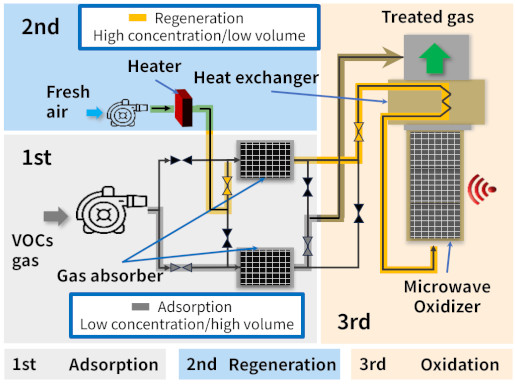
SRMO treatment process schematic
-
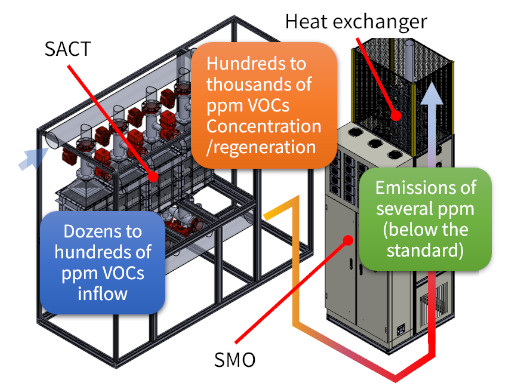
SRMO processing capacity
-
Gas
typeInput gas concentration
[ppm]Processing temperature
[℃]Concentration after oxidation
[ppm]Toluene 2000 650 400 2000 900 Not detected 1000 600 80 1000 850 Under 1 Benzene 1000 600 80 1000 800 Not detected 1000 850 Under 2.5 1000 900 Not detected SRMO processing test results
Specifications
Size and power may vary depending on gas composition.
| MODEL | Unit | SRMO20 | SRMO50 | SRMO100 | SRMO200 | SRMO300 |
|---|---|---|---|---|---|---|
| Throughput | m3/min | 20 | 50 | 100 | 200 | 300 |
| Static pressure | mmAq | 240 | 430 | 430 | 240 | 240 |
| electrical power | kWh | 25 | 52 | 85 | 115 | 145 |
| Inlet diameter | Φ | 150 | 200 | 250 | 450 | 550 |
| Size | L [mm] | 3000 | 3000 | 6100 | 7600 | 7600 |
| W [mm] | 1200 | 2400 | 3500 | 4050 | 4050 | |
| H [mm] | 2800 | 3000 | 6300 | 6700 | 7620 |