Microwave
Methane
Cracking
Microwave Methane Pyrolysis
-
Microwave Methane Pyrolysis is a cutting-edge technology that directly decomposes natural gas(CH4) into hydrogen(H2) and solid carbon(C). This method offers several distinct advantages over conventional hydrogen production processes:
-
Instantaneous Reaction & Control: Due to low thermal inertia, the heating and cooling processes are exceptionally rapid. The system can be cycled on and off instantly, making it an ideal match for the intermittent nature of renewable energy sources such as solar and wind power.
-
Volumetric Heating: Microwave energy heats the entire volume of the medium uniformly and rapidly. This minimizes energy loss and significantly enhances heat transfer efficiency compared to surface-level heating.
-
Selective Heating & Catalytic Activation: This technology allows for the selective heating of catalysts or carbon particles, raising the localized reaction temperature. This enables high reactivity while maintaining a lower overall process temperature, optimizing energy consumption.
-
Non-Equilibrium Plasma Utilization: When microwave plasma is generated, methane molecules can be effectively dissociated using only electron energy without excessively raising the bulk gas temperature. This characteristic maximizes overall energy efficiency.
| Category | Microwave Pyrolysis | Steam Methane Reforming (SMR) | Water Electrolysis | Thermal Pyrolysis |
|---|---|---|---|---|
| Materials | Methane (CH4) | Methane + Water (H2O) | Water (H2O) | Methane (CH4) |
| By-product | Solid Carbon (C) | Carbon Dioxide (CO2) | Oxygen (O2) | Solid Carbon (C) |
| Energy efficiency | Very High (Selectively heating) | High (Suitable for large scale) | Very Low (High power consumption) | Middle (High temperature) |
| Carbon emission | Zero (Turquoise Hydrogen) | High (Grey Hydrogen) | Zero (Green Hydrogen) | Zero (Turquoise Hydrogen) |
| Operational characteristics | Highly flexible | Requires continuous operation | Flexible | High-temperature standbys |
| Features | Compact & Distributed system | Industy-standard technology | Eco-friendly but high-cost | Monetizing Carbon Black |
Microwave
Plasma
Liquid
Ferilizer
Microwave Plasma-based Liquid Fertilizer Production Technology
-
Our Microwave Plasma-based Liquid Fertilizer Production is an innovative technology that dissociates atmospheric nitrogen (N2) in a plasma state and dissolves it into water as nitrates(NO3-) or nitrites(NO2-), forms that plants can readily absorb.
-
Eco-friendly Process (Zero Carbon): By utilizing only air, water, and electricity (renewable energy), this method produces Green Fertilizer without burning fossil fuels, resulting in zero CO2 emissions throughout the production process.
-
High-Efficiency Energy Transfer: Microwave technology can generate high-density plasma without electrodes. This eliminates impurities caused by electrode corrosion and ensures high energy efficiency by concentrating power directly on the dissociation of nitrogen molecules.
-
On-site Customized Production: Unlike conventional methods requiring massive industrial facilities, our system is highly modular and compact. It can be installed directly on farms or in smart-farm facilities to produce Plasma Activated Water (PAW) on-demand, drastically reducing logistics and transportation costs.
-
Multi-functional Benefits (Sterilization & Growth Promotion): The resulting liquid fertilizer contains not only nitrogen nutrients but also Reactive Oxygen Species (ROS). These act as a Biostimulant, providing soil and seed sterilization while simultaneously boosting the plant’s immune system and growth potential.
| Category | Microwave Plasma | Haber-Bosch | Low temperature Plasma (DBD/Arc) |
|---|---|---|---|
| Operational conditions | Atmospheric pressure, electrode-less, high-density state | High temperature(400~500°C), High Pressure(150~250bar) | Atmospheric pressure, Low temperature |
| Raw Materials | Nitrogen + Oxygen (Air) | Nitrogen + Natural gas (Hydrogen) | Nitrogen + Oxygen (Air) |
| By-product | Nitrate aqueous solution (NO3-) | Ammonia (NH3) | Nitrate aqueous solution (NO3-) |
| Carbon emission | Zero (Using renewable energy) | Very high (1~2% of global CO2 emissions) | Zero (Using renewable energy) |
| facilities size | Compact/Modular | Massive centralized plant | Small-to-medium scale facilities |
| Energy efficiency | High (0.5~2 MJ/mol) | Highly efficient in mass production | Low |
-
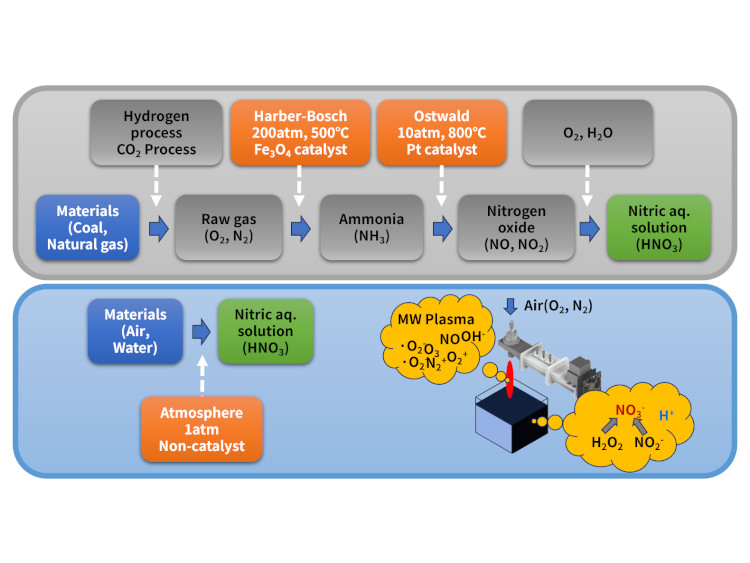
Microwave plasma vs. Haber-Bosch
-
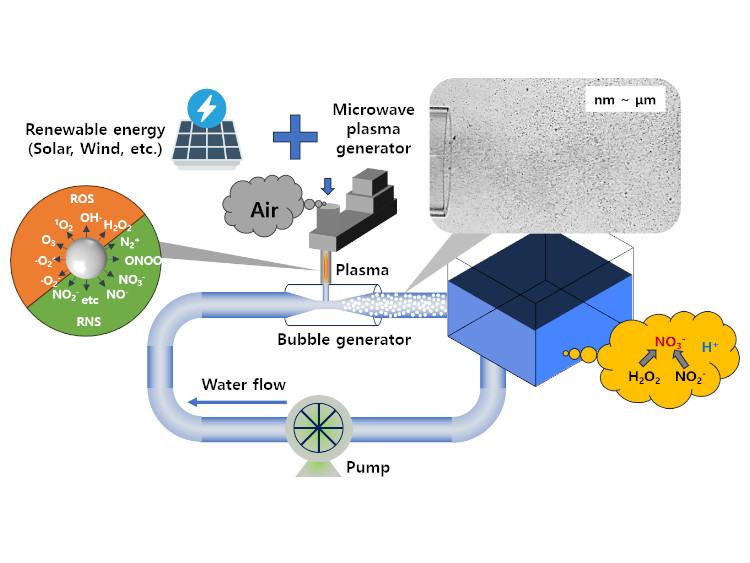
Microwave Plasma Fertilizer Production Overview
Microwave
Air heater
Microwave Air heater
-
The hot air heating technology combining Microwave energy with Susceptors (such as SiC, Carbon, etc.) is a high-efficiency heating solution that overcomes the limitations of conventional resistance heating methods
-
Ultra-fast Temperature Rise & Instantaneous Response: Unlike conventional heaters with high thermal inertia, susceptors generate heat the moment they are exposed to microwaves. This allows for high-temperature hot air within seconds of startup, with equally instantaneous shutdown capabilities.
-
Maximizing Energy Efficiency: Instead of heating the entire furnace or air duct, this system directly heats only the susceptor in contact with the air. By eliminating unnecessary preheating, overall energy efficiency is improved by more than 30–50%.
-
Ultra-high Temperature Generation: Depending on the susceptor material and airflow, the system can instantly reach temperatures exceeding 1,000°C. This is a range that is either difficult to achieve or significantly shortens the lifespan of standard nichrome wire heaters.
-
Miniaturization & Enhanced Durability: The size of the heating unit can be drastically reduced compared to conventional systems of the same power output. Furthermore, as a non-contact heating method, it reduces the risk of physical failures like heating element breakage, leading to lower maintenance costs.
-
Clean Hot Air: Since there is no combustion process, the system is entirely eco-friendly, producing zero harmful gases (NOx, SOx) or CO2 emissions.
| Category | Microwave Air Heater | Eletric Resistance Heater (Nichrome wire) | Gas Combustion Air Heater |
|---|---|---|---|
| Heating method | Direct heating via molecular vibration | Indirect electric resistance heating | Combustion heat of fossil fuels |
| Heating speed | Very fast (Instantaneous response) | Slow (Requires preheating) | Middium |
| Maximun temperature | Up to 1,600°C (Depend on material) | Limited (Heater lifespan issues) | High but difficult to control |
| Energy efficiency | Very high | Middium (High radiation loss) | Low (Exhaust gas loss) |
| Control Precision | Very Precise (Fine power adjustment) | Moderate (Due to thermal inertia) | Low (Difficult to regulate) |
| Eco-friendliness/Sustainability | Superior (Zero carbon emissions) | Excellent (Electric-powered) | Low (CO2 generation) |
-

Small-scale Air Heater
-

4 CMH Microwave Hot Air System
-

20 CMM Microwave Hot Air System